
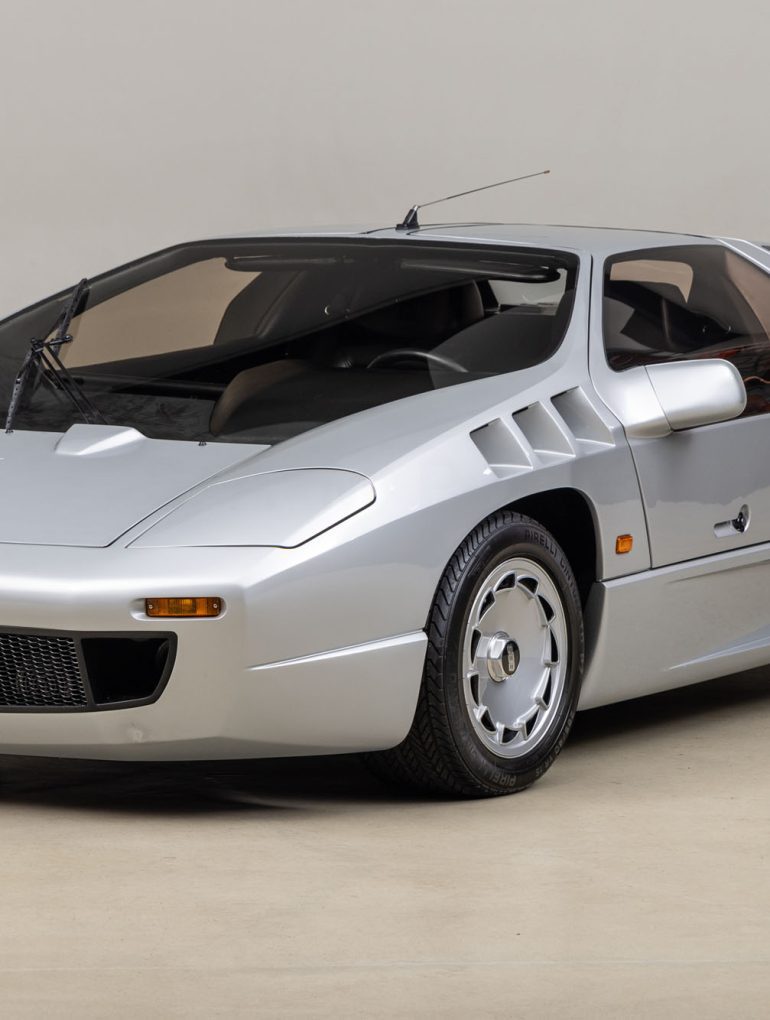
Most supercars announce themselves with a famous badge before the engine ever fires. The Isdera Imperator 108i does the opposite. It asks you to notice the roof mirror, the gullwing doors, the low wedge body, and the strange confidence of a car built by a tiny German firm with Mercedes-Benz hardware behind the seats. For a U.S. collector, that mix is the whole draw. This is not another poster car everyone can name from a childhood bedroom wall. It is a rare German supercar with a paper trail that runs through the Mercedes-Benz CW311 concept, small-batch engineering, and the kind of hand-built decisions modern exotic cars usually hide. The best way to understand it is not to treat it as a lost Lamborghini rival. It is more personal than that. It is what happens when an engineer refuses to let a concept car die and turns an idea into a road car, one slow build at a time.
From Mercedes Dream Car to Small-Company Reality
The origin story matters because this car was never a normal product plan. It began as a design argument on wheels. Eberhard Schulz wanted a mid-engine Mercedes-flavored machine with gullwing drama, and the Mercedes-Benz CW311 gave that wish a shape. Mercedes-Benz itself had already shown how much pull a gullwing experimental car could have with the C 111 program, which the company describes as a high-speed test bed that stirred demand even though it never became a showroom car. Mercedes-Benz’s own C 111 history helps explain why that theme had power among sports-car fans.
The friction came from the gap between attention and production. Big companies can let a concept remain a myth. Small builders cannot. Schulz left the concept-car orbit and founded Isdera in 1982, then brought the Imperator to Geneva in 1984 as a small-series car that kept the spirit of the earlier Mercedes-Benz CW311 while wearing its own identity. That is the first non-obvious lesson here: the car’s value is not only in its rarity. It is in the stubborn act of building the car after the safe answer was no.
Why the CW311 connection still shapes the car’s value
The Mercedes-Benz CW311 link gives the Imperator a stronger story than many boutique exotics. Some small builders chase attention with wild shapes and borrowed engines. This car had a clearer bloodline. Its wedge profile, gullwing doors, Mercedes-sourced V8 power, and cockpit-forward stance all tie back to that earlier concept in a way collectors can explain in one breath.
For American buyers, that story matters at auctions, shows, and private collections. A Countach does not need a footnote. An Imperator does. Once you explain that it grew from a Mercedes-linked concept and was built in tiny numbers, people stop asking why it matters and start asking where one could even be found. That shift is powerful.
The counterintuitive part is that the borrowed identity does not weaken it. It makes it stranger and better. The car sits between factory Mercedes myth and private engineering nerve. That middle ground is narrow, and few cars occupy it with this much visual force.
How Eberhard Schulz turned a concept into a road car
Schulz did not simply sketch a fantasy car and hand the hard work to someone else. He came from engineering circles, worked around major German brands, and built the Imperator through a company whose name came from engineering, styling, design, and racing. That background shows in the way the car was made. It feels like a tool shaped by obsession, not a fashion object dressed up as speed.
A concrete example sits in the body and chassis choice. The car used a tubular steel spaceframe with bonded fiberglass bodywork, a layout that let a small firm create a low, dramatic body without the stamping costs of a large manufacturer. RM Sotheby’s described the Series 2 cars as keeping that spaceframe and fiberglass formula, with the famous gullwing doors still part of the package.
That choice also explains why the car feels different from a mass-market performance car. It was not born from platform sharing or dealer needs. It came from a builder solving one problem at a time: how to make the concept drive, how to cool a Mercedes V8, how to give the driver rear vision, and how to make the thing legal enough for real roads.
Isdera Imperator 108i Specifications That Still Feel Mechanical
The spec sheet looks simple until you understand the setting. A mid-mounted Mercedes V8, rear-wheel drive, a five-speed manual gearbox, and a low body were serious ingredients in the 1980s. Early cars used Mercedes M117 V8 power, while later versions moved through larger and more potent Mercedes or AMG-related V8 setups depending on build and customer request. Sources differ on exact outputs by car, which is normal for low-volume machines, but the pattern is clear: Mercedes power sat at the center of the formula.
That matters to U.S. readers because parts, servicing, and trust feel different when a boutique car carries familiar German mechanical roots. Nobody should confuse this with easy ownership. Still, a Mercedes-Benz V8 gives the car a more grounded feel than an exotic engine made in tiny numbers. One good independent Mercedes specialist may understand more of the heart of the car than you would expect, even if the rest of the package remains specialized.
Engine, transmission, and performance numbers that matter
The most often quoted early performance figure is the 390-horsepower test car that reached 176 mph and ran from 0 to 60 mph in about 5.0 seconds in period testing reported through Auto Motor und Sport and Road & Track coverage. Later cataloged Series 2 examples often appear with a 5.0-liter Mercedes M119 V8 and a five-speed manual, with claimed figures around 300 horsepower, 5.1 seconds to 60 mph, and 175 mph at the top end.
Those numbers will not shock someone raised on modern Corvette Z06s, Porsche 911 Turbos, or electric performance sedans. That is the wrong lens. In its era, a 175 mph small-batch coupe with gullwing doors and Mercedes V8 power was not a novelty. It was serious enough to share mental space with Italian exotics, even when it lacked their dealer network and racing fame.
Imperator specifications also show why the car has charm beyond raw speed. A five-speed manual gave the driver direct control, and rear-wheel drive kept the experience old-school. You were not insulated by drive modes and screens. You drove the machine, and the machine answered in steel, glass fiber, heat, clutch weight, and V8 sound.
Chassis layout, body construction, and odd details
The body is where people stare first, but the layout explains the stare. A low mid-engine coupe needs space for cooling, cabin access, luggage compromise, and rear vision. The Imperator solved those issues in ways that look odd from a distance and clever up close. The roof-mounted rear-view periscope is the easy example. It was not there for comedy. It helped the driver see past a body shape that did not care much about normal mirrors.
The gullwing doors add theater, but they also tie the car back to German sports-car mythology. The Mercedes 300 SL made that door style sacred, and the C 111 kept the idea alive in orange experimental form. The Imperator took the cue and made it usable for a tiny set of owners, which is why the door opening still feels less like a trick and more like a handshake with history.
Here is the useful collector insight: the weird details are not decoration. Side exhaust placement, roof mirror hardware, unusual vents, and handmade panels all tell you how the car was solved. Imperator specifications are not a neat showroom brochure. They are evidence of decisions made by a small team trying to turn a dramatic concept into a machine that could cross a real road without losing its soul.
Design, Cabin Feel, and What Owners Actually Notice
The design is easy to mock if you only see it as a wedge with strange vents. Stand near one, though, and the mood changes. It has the blunt, confident stance of a car from an era when aerodynamics still felt visible. Nothing about it is shy. Yet it is not as cartoonish as some 1980s exotics because its surfaces have a German restraint under the drama.
That mix is why the car works for American collectors who already know the obvious icons. A Ferrari Testarossa feels tied to Miami Vice. A Lamborghini Countach feels tied to bedroom posters and scissor-door fantasy. The Imperator feels like it escaped from a Mercedes engineering office after hours. That personality gives it a different kind of presence at events such as Monterey Car Week, Amelia Island weekend, or a local Cars and Coffee where nobody expects to see one.
Why the roof periscope is more than a gimmick
The periscope mirror is the detail people remember. It creates the small bump on the roof and gives the car one of its easiest visual tells. Some markets and later cars used side mirrors as rules demanded, but the roof-view idea remains part of the car’s identity. It says the builder did not want to ruin the side profile unless the law forced his hand.
That is the non-obvious insight: the Imperator’s strangest part may also be one of its purest design choices. A normal mirror would have made the car easier to understand. The periscope kept the body cleaner and kept the concept-car mood alive. It was not the easy answer, and that is why people still talk about it.
You can see the same thinking in the front lighting changes across different builds. Early production moved away from the concept’s pop-up headlamp treatment, while later Series 2 cars brought back a look closer to the original study. On most cars, that would feel like a facelift. Here it feels more like the builder arguing with his own sketch across several years.
Interior choices and the handmade supercar problem
The cabin is not the cold science-fiction pod some people expect. Many cars used practical components from established German sources, and some interior parts have been linked to Porsche 928 influence. That makes the inside feel less alien than the exterior. It also reminds you that small manufacturers survive by choosing proven pieces where they can.
For a U.S. owner, this creates a funny split. The switches or trim pieces may feel familiar, but the doors, body, mirror system, and overall packaging are from another planet. A mechanic might recognize part of the cabin, then need patience for the rest. That is small-batch ownership in one sentence.
The rare German supercar label can make the car sound fragile, but that is not the full story. Its handmade nature means each example needs inspection on its own terms. Mileage matters, yet storage quality, cooling health, documentation, wiring condition, and body fit may matter more. A low-mile car that sat poorly can be more demanding than a driven car that had careful hands on it.
Rarity, Market Interest, and the U.S. Collector Angle
Rarity is the headline, but it is also the trap. Many obscure cars are rare because few people wanted them. The Imperator is different. It is rare because the company was small, the build was slow, and the car occupied a narrow space between concept fantasy and road-car reality. Around 30 examples are often cited across the full run, with some sources breaking production into early and later cars in different ways.
That low count makes every public sale a small event. A 1991 Series 2 car offered through RM Sotheby’s in Monterey was cataloged with 1,912 kilometers at the time, Japanese delivery history, a Mercedes V8, and the expected magnetism of a car most people have never seen in person. More recent U.S.-market coverage around another Series 2 example shows how the car now sits in the same conversation as major exotic collectibles, not as a cheap curiosity.
Why low production does not always mean easy value
Scarcity helps, but it does not sell a car by itself. U.S. buyers still ask hard questions. Can it be registered in their state? Who can service it? Are parts available? Does the car have original documents, import records, and clear title history? Those questions become heavier when fewer than a few dozen cars exist.
The counterintuitive answer is that documentation may be worth almost as much as mileage in buyer confidence. A spotless odometer reading looks good in a listing, yet a binder full of invoices, ownership letters, shipping records, and factory or specialist notes can make the car easier to believe. With a car this uncommon, trust is part of the price.
That is where a collector car inspection checklist belongs in the buying process. You would not inspect this machine like a normal used exotic. You would bring a Mercedes V8 expert, a body and paint specialist, and someone who understands low-volume European cars. One person rarely catches every issue on a car this unusual.
What American buyers should compare it with
The Imperator is not a direct substitute for a Ferrari, Lamborghini, Porsche, or Mercedes-Benz AMG car. It is better compared with cars that carry a story larger than their production number: Vector in the U.S., Cizeta in Italy, or the later Isdera Commendatore 112i in Germany. Those machines attract buyers who care about what a car represents, not only how fast it runs.
That is why price guides alone can mislead you. A rare sale may look like a new market level, but condition, build version, country history, and public exposure can swing the result. If the car crosses an auction stage in Monterey or Miami, the room matters. If it trades quietly between two marque fans, the number may tell a different story.
For readers building a deeper garage plan, a guide to Mercedes-powered collector cars can help place the Imperator beside machines with stronger parts support and wider recognition. The smart play is not to chase it because it is obscure. Chase it because the story fits your collection and you are ready for the ownership burden that comes with that story.
Conclusion
The Imperator is not famous in the easy way. It does not win attention through racing trophies, dealer posters, or a badge that needs no explanation. Its power comes from a more specific place: one engineer’s refusal to let a Mercedes-linked idea remain trapped as a concept. That gives the car a human edge most supercars lack. The Isdera Imperator 108i is part specification sheet, part design experiment, and part private act of will. For American collectors, that mix can be thrilling, but it should also slow you down. Buy the story only after you verify the car. Check records, build details, import history, cooling behavior, and the condition of every odd piece that makes the car special. The right example is more than a rare object. It is proof that one determined builder can leave a mark larger than his factory. Treat it with that level of care, and the car rewards you before the engine even starts.
Frequently Asked Questions
How many Imperator 108i cars were built?
Most reliable collector sources place total production at about 30 cars, though smaller counts may appear when sources split early cars, later Series 2 cars, or numbered chassis records. Because production was low and hand-built, individual car history matters more than a simple total.
What engine does the Imperator 108i use?
It used Mercedes-Benz V8 power in different forms across the run. Early cars are often linked with M117 V8 engines, while later examples may carry larger Mercedes or AMG-related V8 setups. Build records should confirm the engine in any specific car.
Is the Imperator 108i related to Mercedes-Benz?
Yes, through the Mercedes-Benz CW311 concept and Mercedes-sourced mechanical parts. It was not a regular Mercedes production model. Schulz built the road car under his own Isdera brand after the concept path did not become a factory Mercedes program.
Why does the Imperator 108i have a roof mirror?
The roof-mounted rear-view system helped solve rear visibility while keeping the side profile cleaner. It became one of the car’s signature details. Some cars, especially those built for markets with different rules, also received side mirrors.
Is the Imperator 108i legal to import into the United States?
Most examples are old enough to pass the federal 25-year import age rule, but state registration can still vary. California can be tougher than many states. Buyers should check title, customs documents, emissions rules, and state DMV requirements before money changes hands.
What makes the Imperator 108i valuable to collectors?
Its value comes from the Mercedes-linked concept story, tiny production, gullwing design, Mercedes V8 power, and the fact that few people have seen one in person. Condition, documents, originality, and known ownership history can change buyer confidence fast.
Is the Imperator 108i expensive to maintain?
It can be expensive because the car is hand-built and body or trim pieces may be hard to replace. The Mercedes engine base helps, but the chassis, doors, cooling layout, and unique mirror hardware need specialist care. Pre-purchase inspection is not optional.
Is the Imperator 108i better than a Lamborghini Countach?
It depends on what you want. The Countach is more famous and easier to place in pop culture. The Imperator is stranger, rarer, and more tied to German concept-car history. For some collectors, that quieter story is the stronger pull.